
The last time I wrote one of these updates was June 2025. At the time, I said I would try to provide them monthly.
Apparently, I use the word “monthly” loosely.
A great deal has happened at Advanced Sports Logic since then. Rather than walk through every development, I want to focus on the changes that matter most to customers and to the future of ASL.
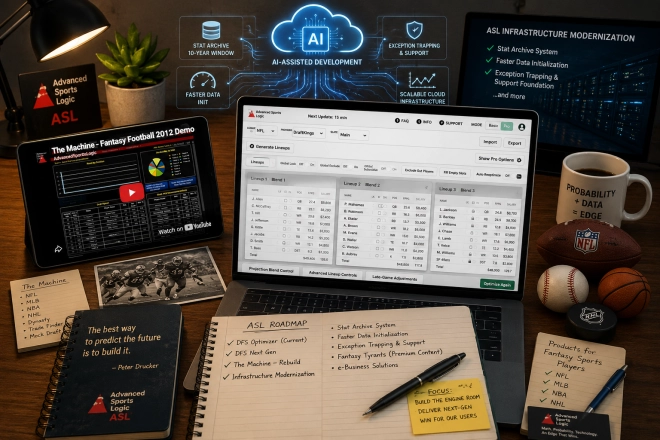
The biggest change is artificial intelligence. AI has dramatically increased what ASL can build and maintain with limited resources. We are applying that increased capacity to the current DFS Optimizer, the return of The Machine, and the shared technology that will support ASL’s next generation of products.
AI Has Changed ASL’s Development Capacity
In April, I began using GitHub Copilot heavily inside ASL’s Microsoft Visual Studio development environment.
Copilot does not independently understand ASL’s products or decide how they should work. I still have to define the architecture, explain the requirements, review the proposed solutions, catch bad assumptions, test the results, and make the engineering decisions.
However, once it is properly directed, it can perform an enormous amount of work.
During June, I made 59 software commits across 265 files. Nearly 20,000 lines of code were added or removed. In July, another 38 commits affected 156 files, including approximately 10,100 meaningful lines of software, configuration, documentation, and planning work.
Not every changed line has equal value, but the scale is unmistakable. Work that might previously have taken many months can now be completed much faster.
I am also able to operate multiple AI-assisted development environments across two laptops and ASL’s Azure virtual machine. At times, it feels like I am bouncing among three separate development conversations, keeping each one moving while the others continue working.
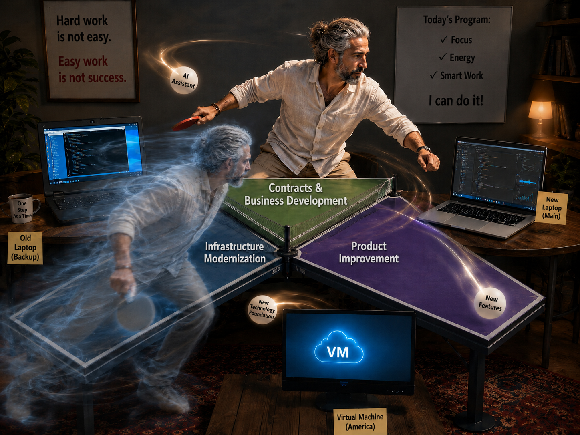
This has changed how I think about ASL’s future. I no longer believe our progress depends primarily on raising enough capital to hire a large software-development team. We can now complete much more of the core work internally and reserve contractors for areas where they provide clear additional value, such as professional graphics design and specialized partner materials.
The Current DFS Optimizer Is Becoming the Next Generation
For some time, we discussed building an entirely separate next-generation DFS Optimizer.
I have changed that plan.
The current optimizer has been operating since 2018. During that time, it has accumulated years of real-world corrections, integrations, lineup rules, data-handling logic, and solutions to problems that only become obvious after customers begin using a product.
There is too much battle-hardened technology inside the current optimizer to throw it away.
Instead, the current product will evolve incrementally into the next generation. This should save substantial time and money while allowing customers to benefit from improvements as they are completed.
Recent work has included moving much of ASL’s technology to Microsoft’s newer .NET 8 platform, strengthening data-source integrations, improving security, modernizing cloud-processing functions, and making deployments more reliable.
We also fully resolved the known issues surrounding lineup reoptimization.
Reoptimization allows a customer to update lineups after a DFS slate has begun while preserving players whose games have already started. This is particularly important in sports such as baseball, where starting lineups may be announced shortly before each individual game.
ASL also supports automatic reoptimization. When later information changes a lineup, the optimizer can rebuild the adjustable portion and email updated lineups to the customer before the remaining games begin.
Other recent improvements include:
- More dependable player locking, excluding, and switching.
- Better protection while updated sports data is being loaded.
- Persistent player exclusions when customers leave and return to a slate.
- Improved DraftKings and FanDuel lineup import and export.
- Better handling of unusual players, including two-way baseball players.
- A five-stage rapid-action stress test that the optimizer passed successfully.
At the end of April, the optimizer’s back-end reached a no-known-issues status for the first time since the product went live in 2018. New issues will always surface in complex software, but the underlying system is becoming more stable, current, and maintainable.
We also created a new one-minute promotional video for the DFS Optimizer.
The video tries to cover too much in one minute. It should eventually become two videos: a shorter marketing video and a longer product demonstration. Nevertheless, it gives a good overview of the depth of the current product and provides a strong starting point for presenting what ASL has built.
The Machine Is Coming Back
I know this is the update many longtime ASL customers care about most.
The Machine was ASL’s flagship full-season fantasy sports product and the top-selling app in CBS Sports Fantasy App Central from 2012 through 2014. When CBS closed App Central, we continued independently for two more seasons before retiring the product at the end of 2016.
We have never lost the recipe.
ASL still has the original code, the mathematical functions, the product concepts, and the accumulated knowledge behind The Machine. What has changed is our ability to understand and reuse that material.
AI can now help analyze the old codebase, reconstruct how individual pages operated, document the underlying behavior, and assist in moving the useful pieces into modern technology.
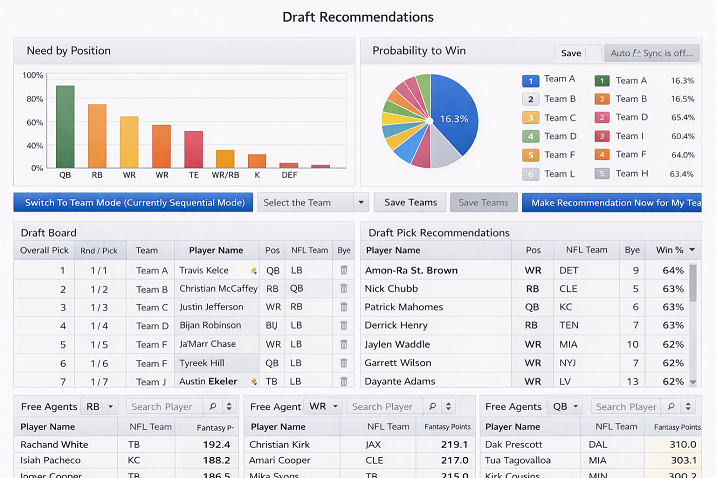
Earlier this year, I gave ChatGPT portions of The Machine’s original user-interface code. From that code, it produced rough drawings and functional descriptions for the product’s 57 pages. I was impressed by how accurately it understood what the pages were designed to do.
There are really two related efforts.
The Machine — Rebuild is an attempt to bring enough of the old product back to life to demonstrate its pages, math, and operation in ASL’s modern environment.
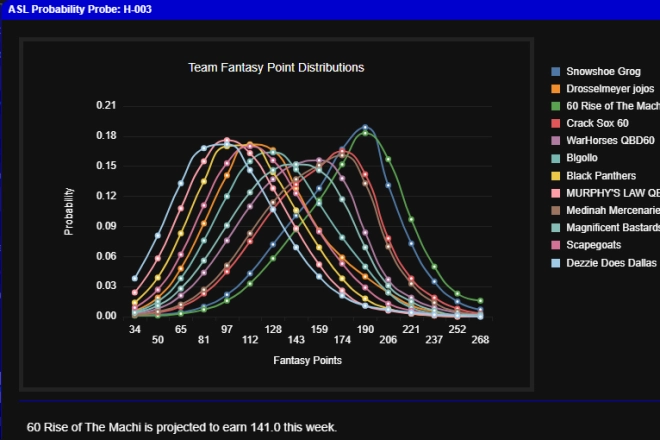
The Machine — Next Generation is the long-term product. It will retain the probability-based approach that made the original Machine special while using modern cloud processing, a modern interface, improved correlation mathematics, and support for more sports.
The first-generation Machine focused on NFL fantasy leagues. The next-generation vision includes MLB, NBA, and NHL as well.
The old Machine contained 13 specialized underlying mathematical functions. Those functions powered tools for draft recommendations, trades, free agents, lineup decisions, playoff probabilities, and full-season team analysis.
The previous product was found to increase a customer’s probability of winning by approximately 2.7 times. Our goal is not merely to reproduce it. Our goal is to build something substantially more powerful.
Building the Engine Room
The visible products are only part of the work.
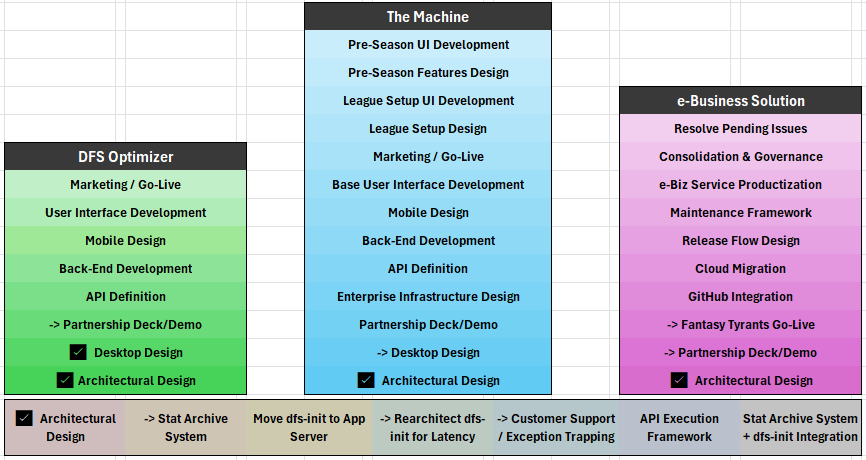
ASL has now begun building three strategic infrastructure systems underneath them. These systems will support the DFS Optimizer, The Machine, Fantasy Tyrants, future projections, and potential white-label products.
The Ten-Year Stat Archive
ASL is building a sliding ten-year archive of historical NFL, MLB, NBA, and NHL player statistics.
This archive will provide a consistent foundation for historical testing, projection development, product-quality analysis, and future statistical tools.
It is also an essential building block for the Taguchi Brain, ASL’s planned system for evaluating large numbers of strategy combinations and identifying the most effective and stable configurations.
Faster Data Initialization
Before the DFS Optimizer can generate lineups, ASL must collect and organize projections, games, player status, salaries, and related information from numerous sources.
One of the most difficult parts is player identity.
Different providers may spell names differently, use different abbreviations, assign different team formats, or identify the same player using unrelated internal numbers. Resolving these differences is computationally expensive and currently occurs too close to the time-sensitive data-update process.
We are moving the heavy identity-matching work into parallel cloud processing. This should make updates faster, lower the load on ASL’s main servers, and improve reliability across our products.
Exception Trapping and Customer Support
ASL already captures detailed information when software problems occur. We are now turning that capability into a shared service available across ASL’s server software, cloud functions, and user interfaces.
This will help us diagnose problems faster and reproduce the exact conditions that caused them.
It will also become the foundation for a more complete customer-support system capable of coordinating support requests, screenshots, files, customer communications, reproducible test inputs, and development follow-up.
This work may not look exciting on a product page, but it makes everything above it faster to build and easier to support.
Fantasy Tyrants Has a Defined Path
When I wrote the previous update, I said Fantasy Tyrants would launch “in the near future.”
The future took longer than expected.
The website and subscription structure proved more complicated than anticipated, and securing the right anchor-content partner took time. We have now selected RotoBaller as ASL’s intended premium-content source.
The current plan is to begin with MLB in 2027 and also cover NFL in 2027. The broader Fantasy Tyrants structure has already been prepared for NFL, MLB, NBA, and NHL.
Fantasy Tyrants will provide premium fantasy content for dynasty, redraft, and daily fantasy players. It will also complement ASL’s software products by helping customers understand the players, strategies, and decisions behind the numbers.
The goal is not simply to publish more articles. It is to combine strong fantasy analysis with ASL’s probability-based tools and technology.
What Comes Next
ASL is currently concentrating on shared infrastructure because it makes every later product easier to build.
Once this phase is complete, I plan to return to meaningful work on:
- The Machine — Rebuild.
- The next-generation DFS Optimizer.
- The Machine — Next Generation.
- The e-Business Solution and Fantasy Tyrants.
These are no longer separate projects built from scratch. They increasingly share data, infrastructure, mathematical technology, customer-support systems, and AI-assisted development processes.
That is the most important change since my last update.
ASL has moved beyond simply planning its next generation. We are now building the foundation underneath it.
There is still a great deal to do, but progress is moving at a pace that was not possible for us before. I am excited to see how far we can take it.
And I will try not to wait another fourteen months before writing the next update.
