
We've reached a major milestone in the rebuilding of The Machine!
This week, we completed the last major group of pages from the original product: League Setup. That means the entire desktop user interface of the legacy Machine has now been rebuilt using modern technology!
There's still plenty of work ahead to connect the underlying mathematics, league data and automation, but having all the original screens back is an exciting accomplishment.
So what's the big deal about Setup? After all, who gets excited about filling out configuration forms?
Well, there are 25 Setup pages in The Machine. That's a lot! And there's a very good reason for it.
The Machine was designed to evaluate nearly every decision a fantasy football manager can make based on its impact on the probability of winning the championship. But to make those calculations meaningful, The Machine needs to understand much more than player projections. It needs to understand your league.
Fortunately, that doesn't mean you have to fill out 25 pages! Once The Machine is integrated with the major fantasy league providers, most of that information will be imported automatically. The Setup pages let you verify the information, fill in anything the provider couldn't supply, and correct or override settings as needed.
A player who is extremely valuable in one league might be considerably less valuable in another. Different scoring rules, starting lineup requirements, roster sizes, draft formats, keeper rules, schedules and playoff structures can all change which decisions give your team the best chance to win.
That's what these Setup pages are all about.
Understanding Your League
The Machine's Setup pages cover five broad areas:
-
League Structure and Rosters — Teams, divisions, conferences, player pools, roster limits and player ownership.
-
Lineups and Scoring — Starting requirements, position eligibility and detailed scoring rules for offensive players, defensive players, team defenses and coaches.
-
Drafts and Keepers — Draft formats, pick ownership, keeper rules, draft-pick costs and auction budgets.
-
Schedules and Competition — Weekly matchups, standings, victory points, playoff qualification and championship schedules.
-
Transactions and League Management — Waiver systems, bidding rules, trade deadlines, current league information and provider-specific settings.
The 25 Setup entries include some alternative pages for different league providers, so an individual manager won't see all 25 at once. The Machine presents the configuration options appropriate to that league.
Let's look at some examples of just how extensive this gets.
League Structure: Not Every League Is Created Equal
Most of us play in leagues with 10, 12 or perhaps 16 teams. But The Machine was built to handle much more complicated arrangements, including leagues with multiple conferences and separate player pools.
For example, we've tested the rebuilt interface with a sample league containing 96 teams across four conferences, with two available copies of each NFL player in each conference's player pool.
Imagine trying to evaluate a trade or waiver pickup in such a league. A player might already be owned by another team, but an eligible copy could still be available in your conference. Or the same player might be owned in another conference that shares your player pool, making him unavailable to you.
The Machine needs to understand those distinctions before it can make a meaningful recommendation.
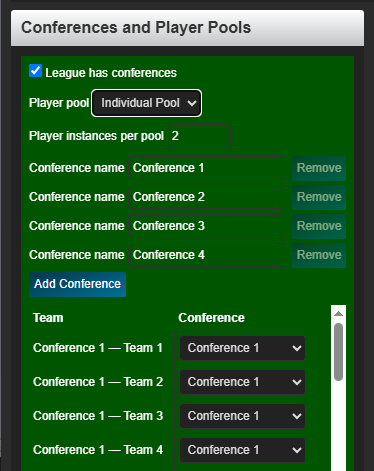
The Machine supports complex conference structures, including independent player pools and multiple copies of the same NFL player.
The Setup pages also manage individual team rosters, divisions and player assignments. The rebuilt Roster Management page supports drag-and-drop editing, team and sequential roster views, and separate player-selection lists to make these configurations easier to manage.
Scoring and Starting Lineups: The Details Matter
Here's another example. Suppose two fantasy leagues have exactly the same teams and players, but one uses standard PPR scoring and the other awards tight ends extra points per reception.
Should The Machine recommend the same players in both leagues? Of course not.
Or suppose one league starts a single quarterback, while another has a superflex position that allows a second quarterback. That changes the value of quarterbacks, roster depth and potentially every draft and trade decision.
The Machine's Setup pages support a wide range of offensive, defensive and coaching positions, with configurable roster limits and starting lineup eligibility. The position catalog includes 27 position definitions, extending well beyond the usual QB, RB, WR and TE.
And the scoring rules go into remarkable detail. There are 98 scoring definitions across seven groups, including passing, rushing, receiving, kicking, team defense/special teams, individual defensive players and coaches.
These include familiar settings such as reception points, passing yards and touchdowns, but also more specialized rules such as touchdown-distance bonuses, field-goal distances, missed kicks, defensive return yards, individual defensive tackles and even coaching results.
Scoring can also differ by position, with fractional points and penalties where applicable.
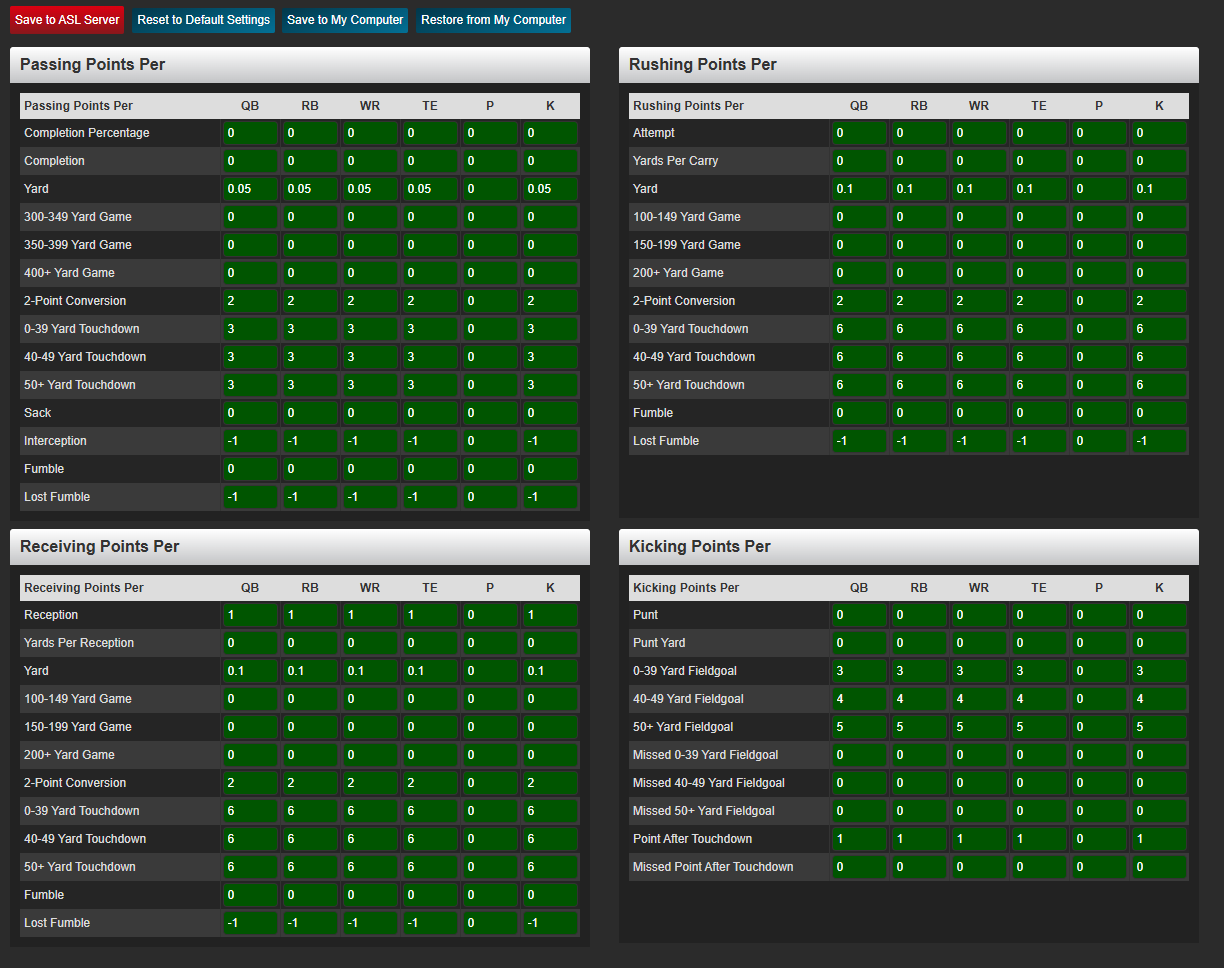
The Machine's scoring configuration goes far beyond standard PPR, allowing detailed rules for individual positions and scoring events.
These details matter because The Machine's projections must ultimately be converted into fantasy-point probability distributions under the actual scoring rules of your league. Those distributions become the foundation for its season simulations and championship-probability calculations.
Drafts, Keepers and Pick Ownership
In last week's update, we explored The Machine's preseason tools for evaluating keepers, trades and draft picks. Those tools depend on knowing precisely how your league's draft works.
The Setup pages accommodate serpentine, round-robin, third-round-reversal and auction drafts. Keeper and dynasty configurations include rules governing how many players can be retained, what draft picks they cost, and how those costs change.
And draft order isn't necessarily fixed.
In leagues where managers can trade draft picks, the original draft position tells only part of the story. A manager might own several first-round selections, no second-round pick and additional picks scattered throughout later rounds.
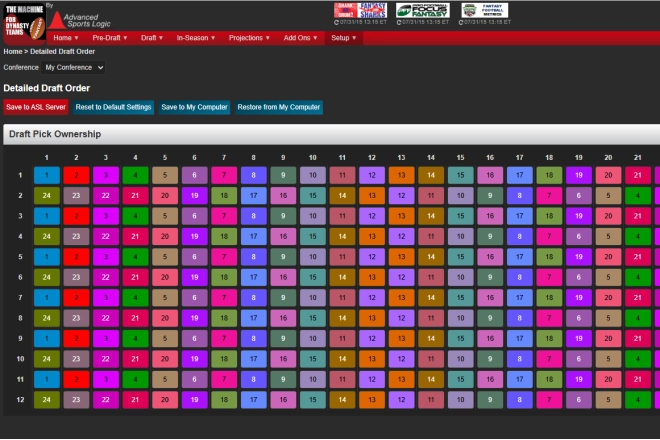
The Machine's Detailed Draft Order page tracks ownership of individual picks, with a color-coded draft board that allows managers to move or exchange picks using drag-and-drop controls.
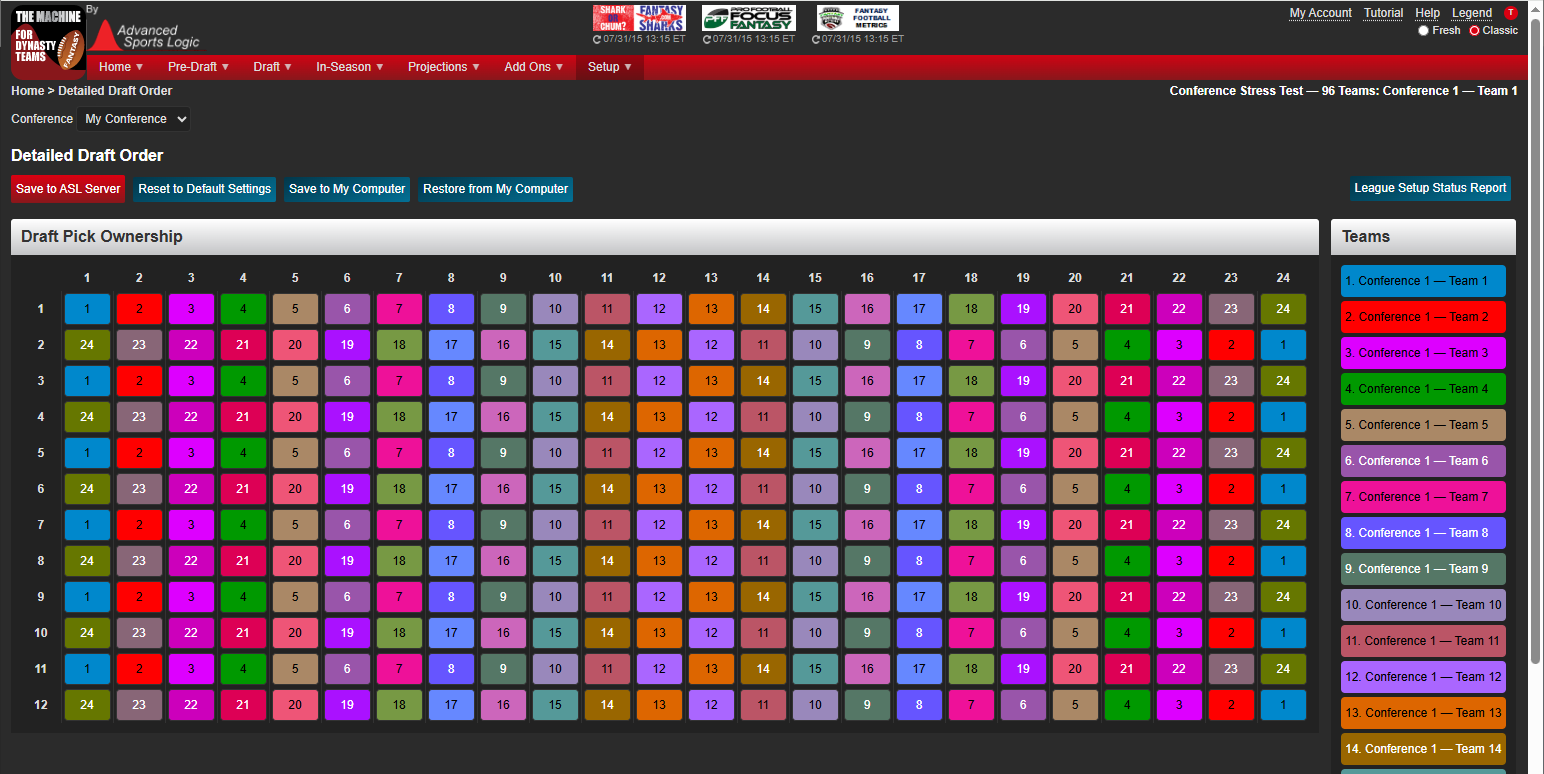
The Detailed Draft Order makes individual pick ownership easy to see and adjust, including picks acquired through trades.
That information is critical to the preseason simulations we discussed last week. A trade involving draft picks can change the resulting rosters across the league and, ultimately, the championship probabilities of the teams involved.
Schedules, Playoffs, Waivers and Trades
The Machine also needs to understand what it actually takes to win your league.
Some leagues determine standings by head-to-head wins. Others use total fantasy points, while still others use Victory Points, which combine matchup outcomes with performance relative to the rest of the league.
The Machine accommodates these different competition formats, along with weekly matchup schedules, multiple matchups in a single week, playoff qualifications and playoff rounds that can span one or two weeks.
And then there are transactions.
Waiver systems vary considerably among league providers. Some use priority systems, others use blind bidding, and the rules can include different processing schedules, bidding budgets and whether zero-dollar bids are allowed.
Trade windows and deadlines add another constraint. It doesn't matter how attractive a proposed trade looks if the deadline has already passed!
These are exactly the kinds of details that distinguish a league-specific recommendation from a generic player ranking.
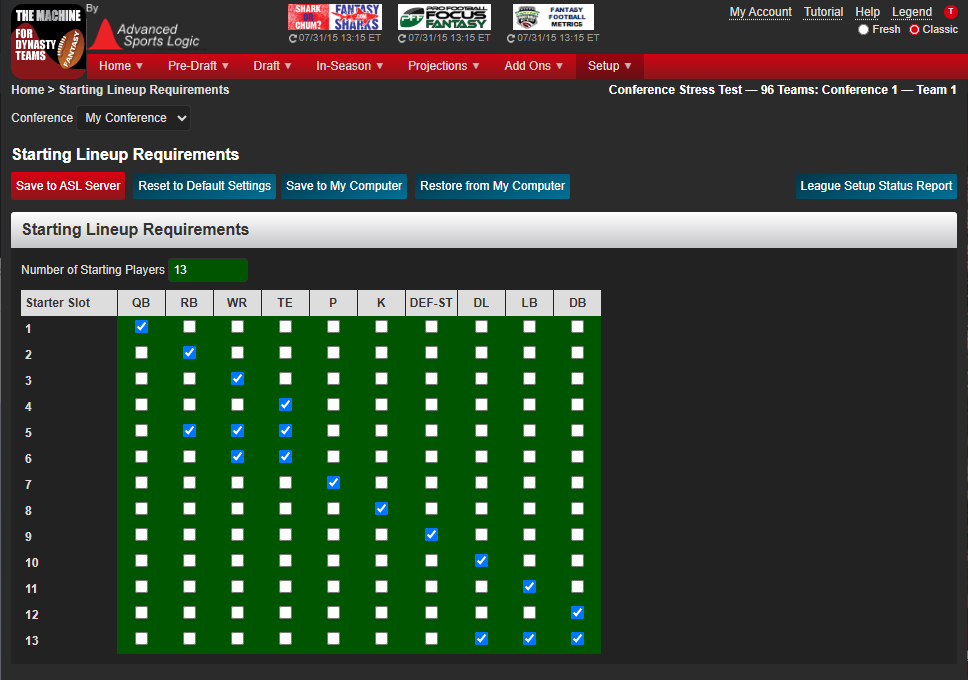
The Machine brings detailed league configuration and player management together so its recommendations can reflect the rules of the league.
The Desktop Rebuild Is Complete. What's Next?
With the legacy desktop screens rebuilt, we've reached an important turning point. Many of the pages already support interactive editing and navigation using sample league data, but the real calculations, persistent league information and live provider connections are still to come.
The next major focus will be building the machinery behind these screens. That includes defining the APIs connecting the user interface to distributed cloud functions, establishing the league data structures, integrating player projections and restoring the mathematical engines and features that make The Machine work.
Once those pieces are connected, we'll have a working Machine with manual league configuration. The next step will be connecting league providers and completing the purchasing and licensing systems, turning the rebuild into an operational product.
Beyond that, there are more exciting opportunities ahead: extending The Machine to other sports, refreshing its visual design and developing a mobile interface.
But for now, I'm excited to have reached this milestone. What began as an effort to recover and rebuild a decade-old product has become a modern foundation for bringing back one of the most ambitious fantasy sports management systems ever created.
You can explore the rebuilt desktop interface yourself at TheMachine.run.
The Machine is coming — and the pieces are coming together!
