
I am often asked by subscribers to the ASL DFS Optimizer: What is the best strategy for winning at DFS? If you are looking for the basketball version, see NBA DFS Strategy.
With the NFL season beginning, this seems like a good time to answer that question.
Every sport has its own nuances, but NFL DFS strategy comes down to three concepts: game script, player correlation, and contest selection/bankroll management.
Before getting into any of them, one thing needs to be clear: no strategy can guarantee a win or a positive return. DFS should be treated as entertainment. Never spend more than you can afford to lose. Play responsibly and keep it fun.
Game Script: Don't Just Project the Players — Project the Game
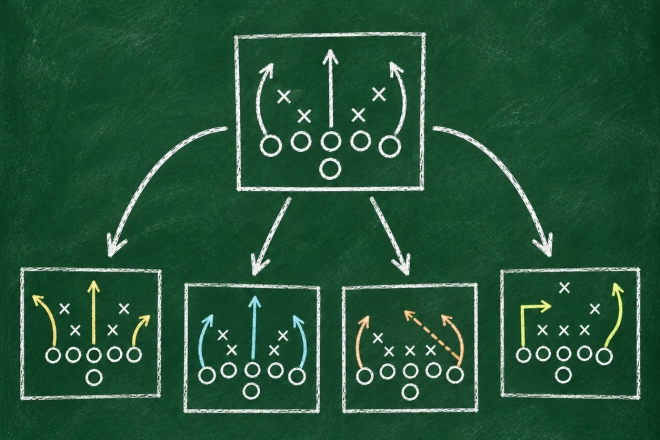
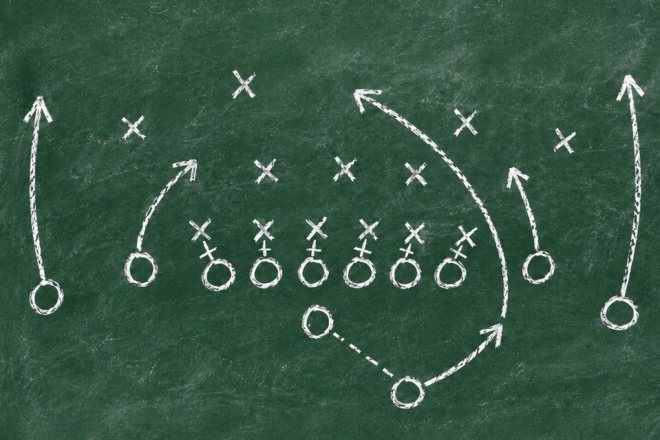
A game script is simply a description of how you expect a game to unfold.
Will it become a shootout between two quarterbacks? Will one team jump to an early lead and spend the second half running out the clock? Will two strong defenses turn the game into a low-scoring battle?
This matters because NFL players do not generate fantasy points independently. What happens to one player changes the opportunities available to everyone else.
An NFL team typically runs only around 60 offensive plays in a game. In 2025, the league average was 61.3 offensive plays per team per game. Every one of those plays must go somewhere.
The Shootout
Let's start with the most fun scenario.
Two teams stay close, both offenses are moving the ball, and neither team has much incentive to slow things down. Passing attempts rise as the teams trade scores.
This is where quarterbacks and their pass catchers can explode together. A quarterback who throws for four touchdowns is almost certainly bringing at least one receiver, tight end or receiving back along for the ride.
The defenses, meanwhile, are generally having a bad day.
This is the classic environment for a QB + receiver stack, possibly with a receiver from the opposing team coming back the other way.
The Early Blowout
Now suppose one team takes a large early lead.
The team ahead has less reason to throw aggressively. It can run the football, keep the clock moving and reduce the number of possessions available to the opponent.
The losing team has the opposite problem. It needs points quickly. That generally means more passing, more clock stoppages and more attempts at chunk plays.
The result can be increased opportunity for the leading team's running back and defense while the trailing team's quarterback and receivers accumulate additional passing volume.
This doesn't mean every blowout produces those results. It means the game environment has shifted the opportunities available to each player.
The Balanced Game
If neither team establishes a strong advantage and neither offense becomes unusually pass-heavy or run-heavy, player usage tends to stay closer to what was originally expected.
These are often the games where projections work best because the actual game script resembles the game script already embedded in the projections.
The Defensive Battle
Then there are the games where neither offense can get moving.
Maybe both defenses are excellent. Maybe offensive lines are overwhelmed. Maybe strong wind or other severe conditions disrupt the passing game.
These situations can create additional opportunities for sacks, turnovers and defensive scoring while suppressing offensive fantasy production.
Expected Performance Is More Important Than Average Performance
This distinction is critical.
A player's historical production helps establish his baseline value and ultimately influences his DFS salary. But DFS projections are trying to answer a different question:
What should this player score today, in this matchup and under today's expected conditions?
Suppose everyone expects Team A to win easily. The projections should already anticipate additional rushing opportunities for Team A and reduced late-game passing.
If Team A then wins easily, nothing surprising happened.
The interesting opportunities occur when you believe the game has a meaningful chance to develop differently from the game script already reflected in the projections.
The consensus point spread and projected game total provide a useful starting point because they summarize expectations for how the game may unfold.
Don't simply look for a high total and conclude, "Shootout."
Ask a better question:
What happens to these players if the game goes over that expectation? What happens if the favorite unexpectedly falls behind? What happens if a supposedly close game becomes a blowout?
That is where game-script thinking becomes useful.
Cross-Correlation: Which Players Rise Together?
Game script leads directly into the second major concept: cross-correlation.
Correlation describes the tendency for the fantasy results of two players to move together.
Positive correlation means two players tend to benefit from the same events. Negative correlation means success for one player can reduce the opportunity available to the other.
There are two kinds worth considering in NFL DFS: same-team correlation and opposing-team correlation.
Same-Team Correlation
The quarterback is the natural starting point.
QB + Receiver: Strong Positive Correlation
When a quarterback completes a touchdown pass, both players score fantasy points. The quarterback receives credit for the passing touchdown and the receiver receives credit for the catch, yards and receiving touchdown.
That is why QB-WR and QB-TE stacks have been staples of NFL DFS strategy for years. Research into successful DFS lineups has consistently found QB-pass-catcher stacking to be one of the most useful forms of NFL correlation.
And by "receiver," I don't mean only players designated WR. Tight ends, slot receivers and pass-catching running backs can all participate in the passing game.
Receiver + Receiver: Opportunity Competition
This relationship is more complicated.
Every time one receiver is targeted, the other receivers cannot be targeted on that play. They are competing for a finite number of passing opportunities.
That creates a negative relationship at the target-share level.
But it does not mean two receivers from the same team can never perform well together. In an unusually pass-heavy shootout, the entire team's passing volume can rise enough for multiple receivers to outperform expectations. Thus, receivers have a negative correlation to each other, but they both have a positive correlation to the quarterback.
So think of receiver-to-receiver correlation as a tradeoff: they compete for slices of the pie, but sometimes the pie gets much bigger.
QB + RB: It Depends on the Running Back
The quarterback-running back relationship is also more nuanced than it first appears.
A traditional rushing back can compete with the quarterback for touchdowns and offensive plays. A handoff is not a pass. So a rushing back has a negative correlation to a rushing quarterback.
But a pass-catching running back is acting as a type of receiver, and can benefit directly from a quarterback's passing production.
That means the player's actual role matters. A third-down back who catches seven passes is very different from a goal-line back who receives 18 carries and almost no targets.
RB + Defense: Positive Game-Script Correlation
Running back and same-team defense is one of the classic NFL DFS correlations.
If a team's defense is playing well and the team establishes a lead, the offense gains more freedom to run the football and drain the clock.
Meanwhile, the opposing offense is taking the field less and is forced to become increasingly aggressive, creating additional opportunities for sacks and turnovers.
So the same game script can benefit both the running back and the defense.
QB + Same-Team Defense
This relationship can vary, but it is generally less attractive when your lineup is built around a pass-heavy game script.
If your quarterback is being forced to throw throughout the game because his team is chasing points, that probably isn't a great environment for his defense.
Again, the key is not memorizing a rule. Ask whether the players in your lineup tell the same story about how the game unfolds.
Opposing-Team Correlation
Correlation doesn't stop at the sideline.
If one quarterback is involved in a shootout, there is a good chance the opposing offense is helping create that shootout.
That is why a QB-receiver stack from one team can sometimes be strengthened by adding a receiver from the opposing team — often called a bring-back.
If your quarterback throws three touchdowns because the other team keeps answering, players on both sides can benefit.
Research into NFL DFS has found game stacks and opposing-player correlation among successful tournament constructions, particularly in higher-scoring, competitive games.
The opposite relationship exists with defense.
A strong offensive performance generally works against the opposing defense. If you're constructing your lineup around one offense having a big game, rostering the defense trying to stop that offense usually tells two conflicting stories.
Why Correlation Matters So Much
Here is a deliberately simplified example.
Suppose a player has three equally likely outcomes: below projection, around projection or above projection.
That gives him roughly a one-third chance of outperforming his projection.
Now suppose you select five completely independent players. The hypothetical probability that all five land in their "above projection" category would be:
(1/3)^5 = 1/243, or about 0.4%.
Now imagine instead that the five players were perfectly positively correlated. They would effectively rise and fall together. In that impossible extreme, the probability of all five rising would approach one-third — 33.3% — rather than 0.4%.
Real football correlations are nowhere near perfect, of course.
But the lesson is important:
Correlation reduces the number of independent things that must go right for your lineup to have an exceptional result.
The downside is equally important. Correlated players can also fail together.
That is exactly the point.
In a large tournament, you generally aren't trying to build a lineup that finishes slightly above average. You want to create a lineup with a realistic path to an unusually high score.
Contest Selection: “Snipe the Shotgun”
Many large-field DFS contests allow players to enter dozens — sometimes as many as 150 — different lineups. Those players are effectively firing a shotgun, spreading their entries across many different possible game outcomes in the hope that one of them hits exceptionally well.
ASL takes a different approach: Snipe the Shotgun.
Rather than trying to cover the entire possibility space, concentrate on your single best lineup — or perhaps your best lineup from each projection provider — and enter that carefully constructed lineup into the large field.
The shotgun player is intentionally creating diversity. His objective is not to rank 150 lineups from best to worst. He is building a portfolio designed to cover many different outcomes, deliberately reducing correlation among his lineups. Ideally, some may even be negatively correlated: one lineup might depend on a particular game becoming a shootout while another benefits from the opposite game script.
That diversification is valuable to the portfolio, because it increases the chance that at least one lineup matches what actually happens. But mathematically, all of those competing scenarios cannot occur at once. Most of the individual shotgun pellets must miss.
The sniper makes the opposite tradeoff. Instead of sacrificing individual hit rate to cover more possibilities, he concentrates on the lineup he believes has the best standalone chance of succeeding.
That is the opportunity behind Snipe the Shotgun. Large-field contests contain enormous numbers of entries built for portfolio coverage rather than maximum standalone hit rate. Over a large sample of contests, your carefully constructed best lineup should therefore have a higher hit rate than the average individual lineup in that field.
Snipe the Shotgun is not about maximizing the chance of finishing first in any one contest. It is about maximizing the quality and hit rate of each lineup you enter, with the goal of producing more consistent winning results over time.
ASL has demonstrated this approach in two previous videos, Snipe the Shotgun and our follow-up Snipe the Shotgun Results & Refinement. The videos go deeper into the strategy, but you do not need them to use the basic approach described here.
Using the ASL DFS Optimizer for NFL
So how do you put all of this into practice with the ASL DFS Optimizer?
For NFL Main and Classic slates, we recommend starting with your normal single-lineup optimization and choosing the projection source you trust most. ASL's Blend projections are a good starting point because you can customize the blend as you gain experience.
Then do something that may sound contradictory:
Turn on Multi-Lineup Mode — even if you only want one lineup.
Why?
Because Multi-Lineup Mode gives you access to the Pro Options, including position-to-position same-team stacking bonuses and penalties.
Set the Multi-Lineup output to 1.
Now the optimizer will produce its highest-rated single lineup while also considering the correlation rules you have given it.
For example, you might begin with settings such as:
QB - WR: +10%
QB - TE: +10%
QB - RB: -5%
QB - DEF: -5%
WR - WR: -10%
WR - TE: -10%
RB - DEF: +5%
These are starting points — not magic numbers.
Depending on the slate, contest size and strategy, bonuses or penalties somewhere around 5% to 15% can be enough to influence lineup construction without allowing correlation to completely overwhelm the underlying player projections.
Experiment.
Run the optimizer with slightly different settings and look at what changes. The goal is to encourage the optimizer toward players whose success fits together without forcing it to select substantially inferior players merely to create a stack.
And remember the nuances discussed earlier. Two receivers aren't automatically a bad combination. A QB and running back aren't automatically negatively correlated. Game script and player roles still matter.
What About Opposing-Team Correlation?
The current version of the ASL DFS Optimizer does not automatically optimize opposing-team position correlation.
But you can still use it.
First let the optimizer construct the best lineup using your same-team correlation settings. Then look at the lineup's implied game scripts.
If you have a QB-WR stack from a game you believe could become a shootout, consider whether adding an opposing receiver makes sense.
If you have an offensive stack against the defense appearing in the same lineup, consider whether those players are telling contradictory stories.
You can make these adjustments directly in the Multi-Lineup Editor.
The optimizer does the heavy mathematical work. You add the football judgment.
Want Several Good Starting Points? Use Cyclone Mode
Sometimes you don't want only one lineup. You want several strong alternatives to examine.
That is where Cyclone Mode becomes useful.
Select the projection providers you want Cyclone Mode to use and run the optimizer. Cyclone will generate the best lineup for each selected projection provider while applying your Pro Option correlation settings.
Now instead of manually inventing several different lineups, you have several independently projected starting points.
There is an information icon beside the Cyclone Mode control in the optimizer that explains the feature in more detail.
The Optimizer Is a Tool — Strategy Still Matters
Our current DFS Optimizer does not automatically model every possible NFL game script or every form of opposing-team correlation.
No optimizer can remove uncertainty from sports.
What it can do is process enormous numbers of player combinations, maximize projected value under the salary cap, apply your correlation preferences and give you strong lineups to work from.
From there, use what you know.
What game story does this lineup tell?
If the quarterback explodes, do the other players in the lineup benefit?
If the running back has the game you are expecting, does the defense fit that scenario?
If you are expecting a shootout, should someone from the opposing offense come along for the ride?
And most importantly:
Are you building a collection of good individual players — or are you building a lineup whose players can win together?
That is the difference between simply optimizing projections and developing a DFS strategy.
ASL continues to improve the DFS Optimizer, and we have an extensive list of additional features planned. We never raise the price for existing subscribers, so as the optimizer becomes more powerful, current subscribers continue receiving the improvements at their existing price.
Bankroll Management: Stay in the Game Long Enough to Improve
Good DFS strategy is not only about building better lineups. It is also about managing how much you put at risk.
Whatever amount you decide to deposit for DFS, be disciplined about how much of it you have in play at any one time.
As a general guideline, I recommend risking no more than about 25% of your available DFS bankroll at one time.
For example, if you have $100 deposited, you might limit your total entries to about $25. If your bankroll grows to $200, that same approach allows you to scale your entries up to about $50. If you go through a losing stretch and your bankroll falls to $60, your entry amount automatically comes down to about $15.
The important part is that your stakes move with your bankroll.
When you are winning consistently, you can gradually scale your potential winnings upward. When you hit a losing streak—and everyone eventually does—you automatically reduce your exposure and preserve enough bankroll to keep playing, learning and refining your strategy.
That resilience matters.
DFS contains a great deal of short-term variance. Even a well-constructed lineup can lose because of an injury, an unexpected game script, a missed field goal or simply because several players underperform on the same day.
Bankroll management prevents a few bad slates from ending your season.
Think of it this way:
Your lineup strategy determines how you play. Your bankroll strategy determines how long you get to keep playing.
The objective should never be to chase losses by increasing your stakes. Let your bankroll determine your entry level, and allow consistent results—not emotion—to move those stakes higher or lower.
Combined with the Snipe the Shotgun approach, this creates a disciplined framework: build your strongest lineup, select contests intelligently, keep your total exposure controlled, and give yourself enough time to learn from the inevitable ups and downs.
For now, I hope these strategies give you some new ways to think about your NFL lineups this season.
Questions and suggestions are always welcome. Contact me at
Play responsibly, keep learning — and have fun.
