
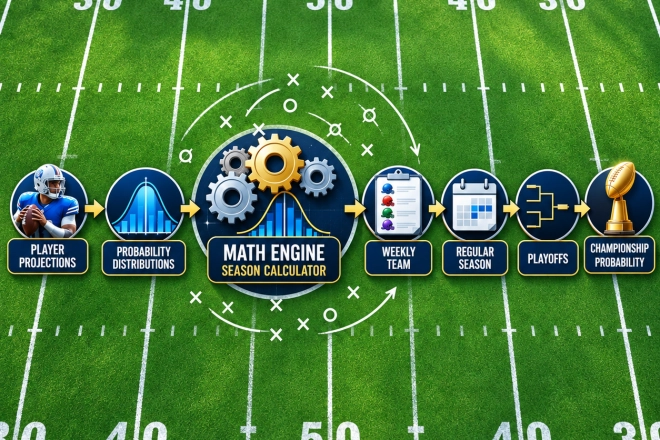
When I first conceived of The Machine, my goal was to create a tool that could evaluate virtually every decision a fantasy football team manager could make based on its impact on the probability of winning the championship—not just some rough estimate based on projected fantasy points, but actual probability calculations that account for the entire league. Last week, I showed you the inner workings of The Machine's Season Calculator. It starts with individual player projections and probability distributions, carries them through every team's weekly matchups and regular-season results, then through playoff seeding and playoff games, ultimately calculating each team's probability of winning the championship.
But there is a problem when we try to apply those same calculations before the season begins. The Season Calculator needs a populated league with team rosters. Before the draft, we don't yet know what each team's final roster will look like. And in keeper and dynasty leagues, our preseason decisions can change the entire draft.
Suppose I decide to keep a particular player. That changes which draft picks I have available, which players other managers can select, and potentially every subsequent selection. If I trade a player for a draft pick, the same thing happens.
How can The Machine evaluate the value of those decisions before we know what the final rosters will look like?
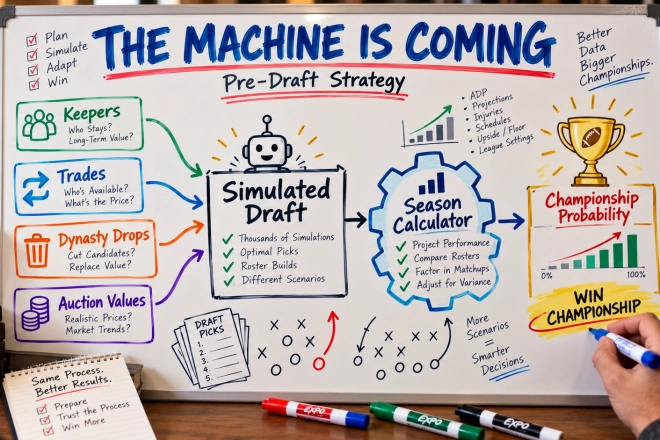
That question led me to create the Simulated Draft, which provides the foundation for several of The Machine's preseason management tools. This week's rebuild brings back the pages that help managers prepare for the season, including keeper decisions, roster changes, preseason trades and auction preparation. As with my previous updates, the rebuilt pages are running with sample data and are viewable at TheMachine.run. The user interfaces and several interactive workflows are in place, but the mathematical calculations and live league connections still need to be restored.
Simulated Draft: Establishing the Baseline
I introduced Simulated Draft in my October 10 update, but it is worth revisiting because it plays an important role in the preseason tools we're looking at today. The idea is straightforward. The Machine's Simulated Draft is designed to simulate the entire draft, selecting the players it believes each team should choose based on its championship-probability calculations.
Naturally, other managers aren't going to follow The Machine's exact recommendations. But that doesn't make the simulation useless. The Machine assumes that the other managers will make what it calculates to be their best decisions. When they don't, they leave opportunities for you to do even better than the simulated baseline. The purpose isn't to predict every selection perfectly. It is to establish a mathematically grounded estimate of what the league could look like after the draft, so that we can evaluate decisions before the draft takes place.
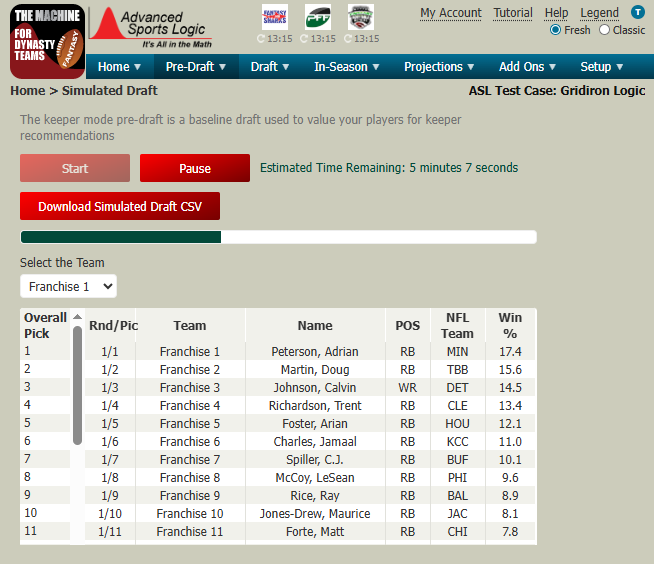
The Simulated Draft establishes a baseline for evaluating preseason decisions.
Standard Keeper Leagues: Is That Player Worth the Pick?
Keeper leagues add another dimension to draft preparation. In a standard keeper league, you can retain a limited number of players from your previous roster, but keeping them often costs you one or more draft picks. So the question isn't simply whether a player is good enough to keep.
Is that player worth more to your team than the draft pick you have to surrender?
A star player might be a terrific keeper at the cost of a late-round pick, but a poor keeper at the cost of an early-round selection. The Machine's Standard Keeper Recommendations page was designed to evaluate these tradeoffs. It compares player values with the cost of keeping them and identifies the combinations of keepers and draft picks that offer the greatest improvement.
But your decisions don't happen in a vacuum. The Machine also estimates which players other teams will keep, so the simulated draft accounts for how those decisions affect the players available to you. It also identifies keeper surpluses and deficits across the league, potentially revealing opportunities to trade players or acquire better draft picks.
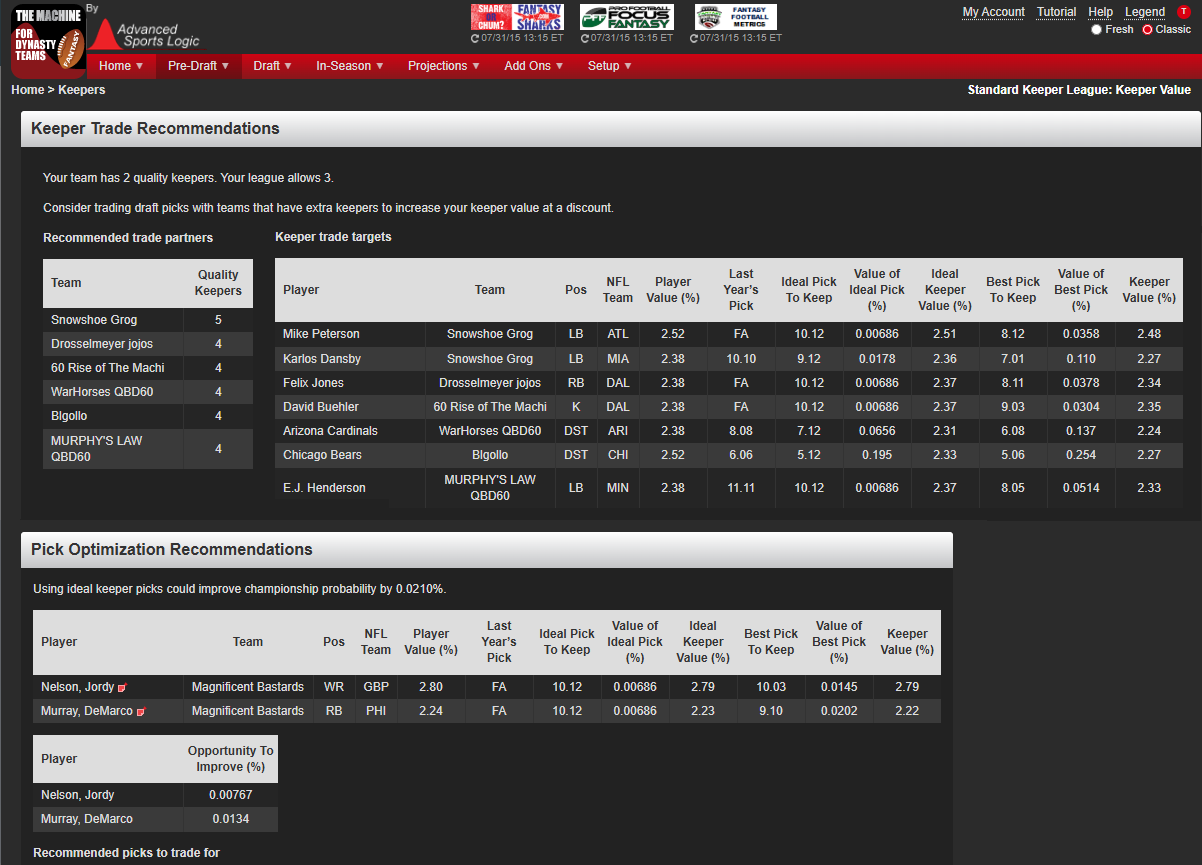
Standard Keeper Recommendations evaluates both the player and the draft pick required to keep him.
Hybrid Keeper Leagues: Looking at the Entire Keeper Group
A hybrid keeper league falls somewhere between a traditional keeper league and a dynasty league. Rather than keeping just a few players, managers retain a substantial portion of their rosters, but not nearly as many as in a full dynasty league. For example, a league that allows managers to keep seven players each season might be considered a hybrid keeper league. The Machine's Standard Keeper functionality already supports keeping multiple players. However, hybrid keeper leagues can have different rules for retaining players and allocating draft picks, requiring a different approach to evaluating keeper decisions.
The Machine's Hybrid Keeper Recommendations page was designed to handle these differences. It evaluates the value of each keeper, the associated draft-pick costs, and how the total value changes as additional players are retained. The objective is to find the most advantageous combination, including how many players to keep.
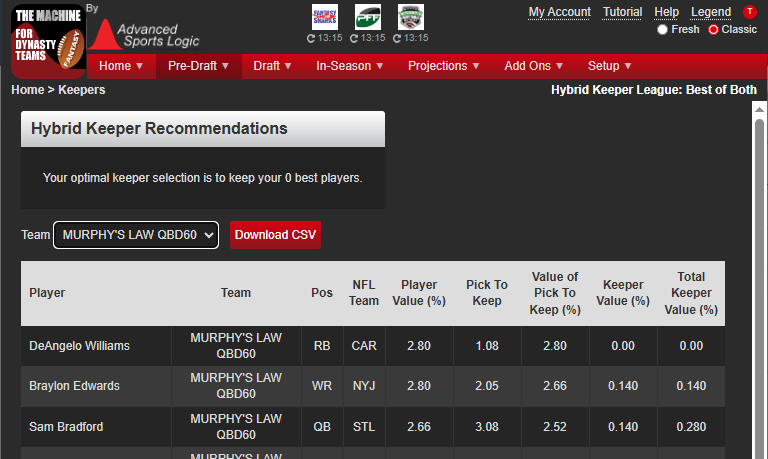
Hybrid Keeper Recommendations evaluates the cumulative value of keeping multiple players.
Dynasty Leagues: Preparing Your Roster
Dynasty leagues introduce another set of challenges. Unlike redraft leagues, where nearly everyone starts over each season, dynasty managers carry most or all of their rosters forward. The upcoming draft generally involves rookies and free agents, so managers must consider which players to release to make room for new additions. That makes roster management a critical part of preseason preparation.
The Machine's Dynasty Drops page helps identify players who can be released to create roster space. Managers can designate players they want to retain, specify which positions they are willing to drop or add, and explore potential replacements. The important question is whether freeing that roster spot creates an opportunity to improve the team.
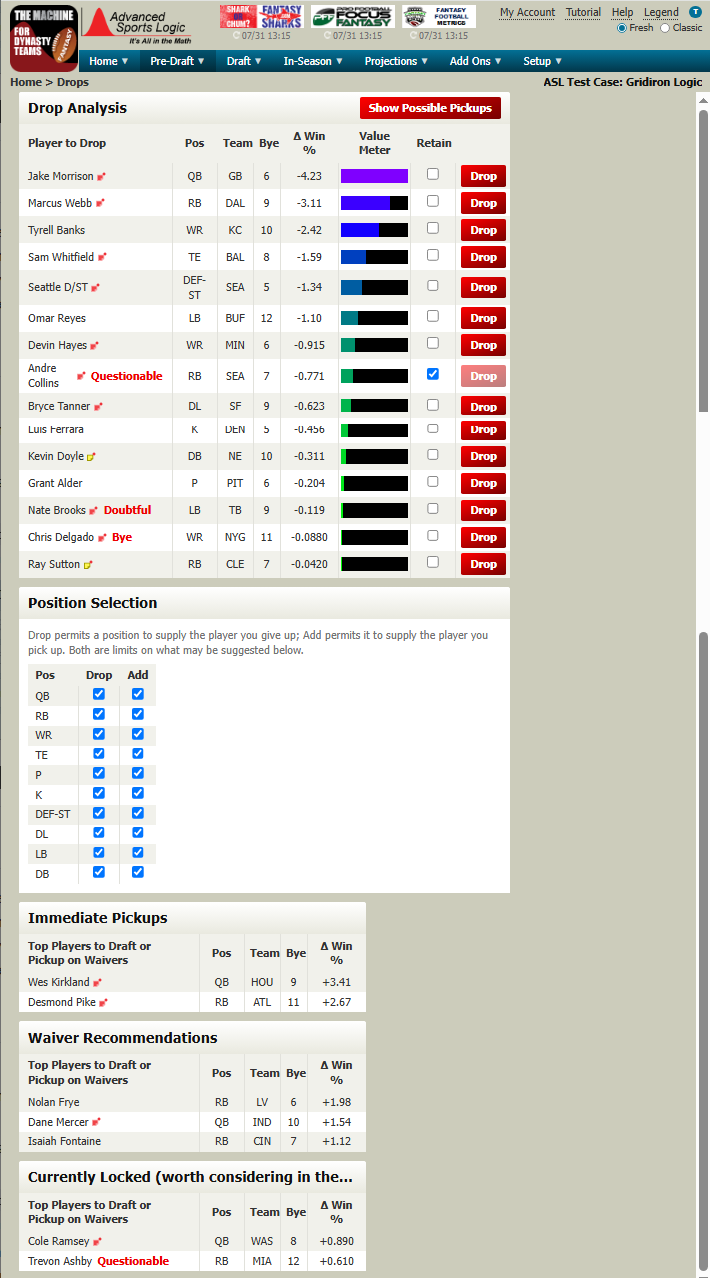
Dynasty Drops helps managers plan roster changes before the season begins.
Preseason Trades: Different Leagues, Different Decisions
Trading before the draft is another area where The Machine's draft simulations become particularly useful. But the type of trade analysis depends heavily on the league format. We've rebuilt three different Pre-Draft Trades pages to address those differences.
Dynasty Trades
In a dynasty league, you may be trading established players, rookie draft picks, or combinations of both. The Machine was designed to consider not only the immediate value of the players involved, but also the impact of the draft picks and the resulting team rosters.
Dynasty trade analysis was designed around a two-stage process. First, The Machine establishes baseline player valuations. Then it simulates the rookie and free-agent draft based on the players and picks available to each team. The Dynasty Trades page lets you select players and draft picks from both teams, examine the proposed exchange from each team's perspective, and queue multiple alternatives for comparison.
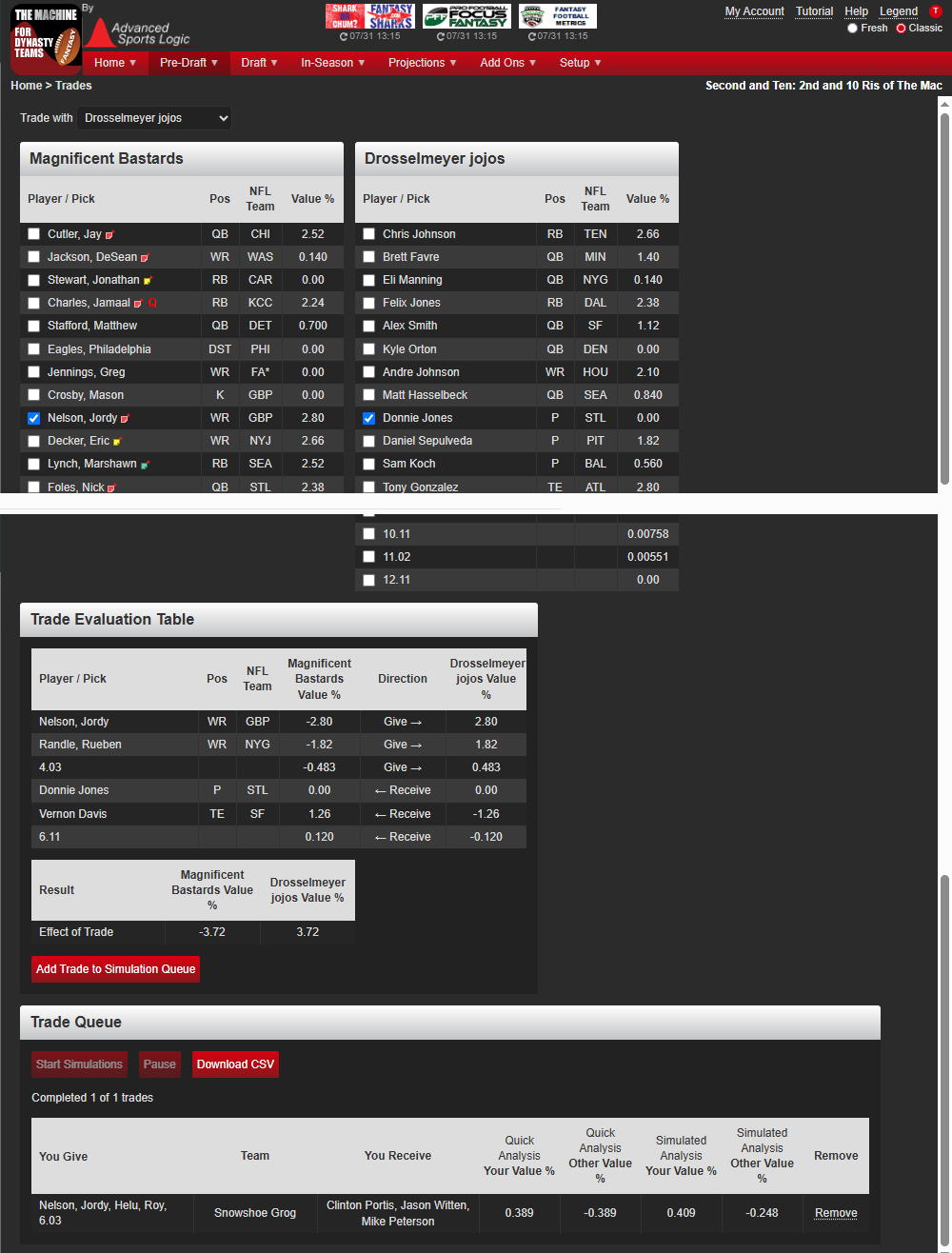
Dynasty Trades brings players and draft capital together in one evaluation.
Keeper Trades
In a keeper league, a trade can change more than the players on your roster. It can change which players you should keep, how many draft picks remain available, and the value of those picks. The Machine's Keeper Trades page is designed to evaluate those consequences together.
Rather than simply comparing the players exchanged, it examines how the proposed trade affects keeper allocations and the resulting draft position. This can reveal opportunities that a conventional player-for-player trade calculator would miss.
Redraft Trades
Even in ordinary redraft leagues, some managers are allowed to trade draft picks before the draft begins. Should you exchange your first-round pick for two later selections? Would moving up several spots improve your chances of assembling a championship roster? How much should you give up to make that move?
The Machine's Redraft Trades page focuses specifically on draft picks rather than existing rostered players. Using the simulated draft as its baseline, The Machine was designed to evaluate how different exchanges of draft positions could affect the resulting rosters and each team's chance of winning. You can construct proposed trades and compare alternatives, with the goal of identifying deals that make sense for both sides.
Auction Drafts: Putting a Dollar Value on Players
Auction leagues present yet another challenge. Instead of having a predetermined draft position, every manager starts with a budget and competes to acquire players through bidding. That means player values need to be expressed in dollars rather than draft picks.
The Machine's Auction Table was designed to take the player values established through its draft analysis and translate them into recommended maximum bids, relative to the league's auction budget. The objective is to help managers allocate their budget intelligently while assembling the strongest possible team. The rebuilt Auction Table currently displays sample player values and bidding amounts. The underlying valuation calculations and downloadable auction table still need to be connected.
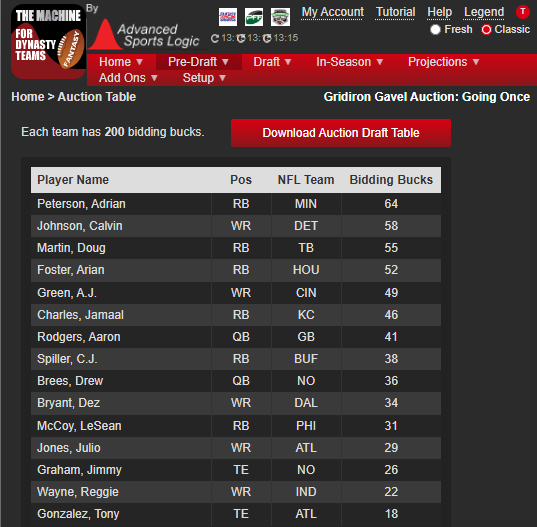
The Auction Table expresses player values as recommended bidding limits for auction preparation.
Bringing Back the Full Power of The Machine
These preseason tools were among the more ambitious features of the original Machine. Some were still a bit rough when we discontinued the product at the end of 2016. My first objective is to restore those capabilities largely as they existed, but running faster on modern technology. Once they are working again, there will be plenty of opportunities to improve them further.
For now, the screens and workflows are coming back together. The examples shown here use sample data, and the real draft simulations, keeper optimization, trade calculations and live league integrations are still ahead of us. But seeing these features come back to life reminds me of the larger vision behind The Machine.
The Machine was never intended to be just a draft cheat sheet, lineup optimizer or trade calculator. It was designed to help fantasy football managers make better decisions at every stage of team management, using the same underlying objective:
Which decision gives my team the best probability of winning the championship?
That includes decisions made long before the first football is kicked off. Next up are the League Setup pages, the final major group of customer-facing screens. After that, we move behind the screens and begin restoring the mathematical engine that makes all of this possible. You can follow the rebuild yourself at TheMachine.run.
The Machine is coming — and championship planning starts long before Draft Day.
