
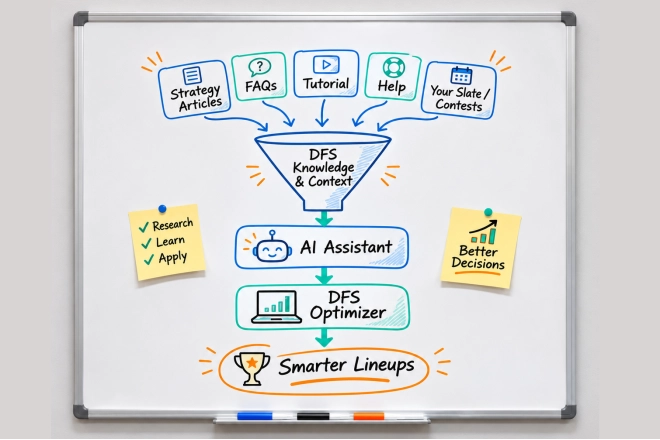

For the past several weeks, I've been publishing updates about the development of the next generation of The Machine. We've made substantial progress, but much of our current work involves building the infrastructure that will support The Machine's mathematical engines. It's important work, but not particularly exciting material for weekly articles.
So, while that work continues, I'm going to focus on the fantasy sports strategies that can help you today and will eventually guide The Machine's AI helper. Although I'm using fantasy football examples, the underlying principles apply to all fantasy sports.
And Week 11 is an excellent time to begin. With only a few weeks remaining before the fantasy football playoffs, it's time for every manager to evaluate their team's position. Perhaps you're sitting comfortably at 7-3, struggling at 3-7, or somewhere in the middle, fighting for a playoff berth.
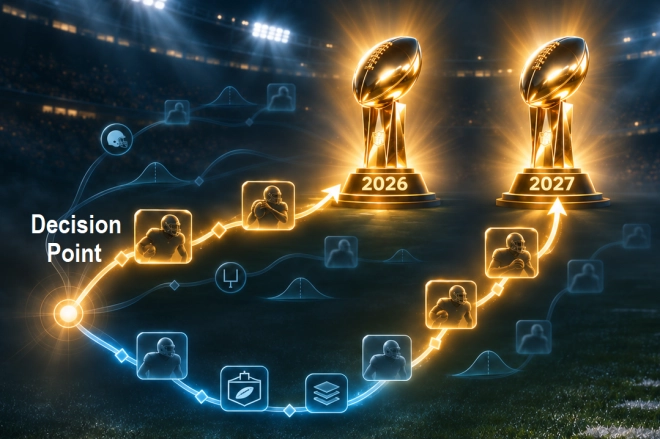
Now is the time to decide: Are you going for a championship this year, or is it time to start preparing for next season?
Making this decision early matters. As the season progresses, other managers will reach similar conclusions and begin competing for the same players and trade opportunities.
Here's my final-stretch multi-point tune-up guide to help you optimize your team for the remainder of the season for whichever type of league you are in—dynasty*, keeper†, or redraft‡.
Waivers
If You're Competing for a Championship
No matter which type of league you are in, if you decide that your team has a realistic chance to make a playoff run, here are some types of waiver moves you can make to harden your team for the remainder of the season:
Handcuffs: Do you have handcuffs for your most important players, particularly your quarterbacks and running backs? Check to see if you can pick up players who could help your team in case one of your players gets injured in this last stretch of the season, or in the playoffs.
Streamers: Look ahead at your remaining schedule, particularly the playoff weeks. Some players are automatic starts regardless of their opponents. Other positions, such as RB2, WR3, FLEX, kicker, and defense, are more matchup-dependent. Look ahead to find the weeks these players have their least favorable matchups, and then check the waiver wire for slightly lesser players but with favorable matchups on those weeks. If you have room on your roster, add these players now before other managers in your league think to stream them. If you are confident of your playoff berth, then do this especially for the playoff weeks.
For example, the New England Patriots defense faces the Kansas City Chiefs in Week 15, a particularly difficult matchup for fantasy defenses. Meanwhile, the Green Bay Packers haven't been quite as strong a defense for fantasy as the Patriots this year but face the Miami Dolphins that same week, a potentially much more favorable matchup.
If you're planning to stream a defense through the playoffs, don't wait for each playoff week to find one.
To make room for these players on your roster, drop fringe sleepers that you have been holding onto.
Look beyond the current week to identify vulnerabilities throughout the remainder of the season. Use waivers to protect against injuries, exploit favorable matchups, and reduce the options available to your opponents. These moves can help keep you competitive against the strongest teams in your league throughout the playoffs.
If You're Preparing for Next Season
If you have determined your team is not a contender this year and you are in a dynasty or keeper league, then it’s time to start improving your team for next year.
Stashes: Whether you are in a dynasty or keeper league, you can start to stash players that have breakout potential for next year or were injured this year and are a bit forgotten. Look for under-the-radar players playing behind productive but aging veterans. In keeper leagues, make sure the player has enough upside and favorable keeper cost to justify using one of your limited keeper slots.
If your fantasy league provides a depth-chart grid that identifies players available on waivers, that's an excellent place to start. You can ask your favorite AI: "Who are the oldest starters at each major position?" Here are some examples from 2026:
| Position | Player | Age |
|---|---|---|
| QB | Aaron Rodgers (Pit) | 42 |
| QB | Matthew Stafford (LAR) | 38 |
| QB | Kirk Cousins (Min) | 38 |
| RB | Derrick Henry (Bal) | 32 |
| RB | Christian McCaffrey (SF) | 30 |
| RB | Saquon Barkley (Phi) | 29 |
| WR | Keenan Allen (SF) | 34 |
| WR | Cooper Kupp (Sea) | 33 |
| WR | Mike Evans (SF) | 33 |
| TE | Travis Kelce (KC) | 37 |
| TE | Tyler Higbee (LAR) | 33 |
| TE | George Kittle (SF) | 33 |
Check the waiver wire for players who might replace these aging veterans in 2027, considering each player's talent, contract situation, and likelihood of earning a starting role.
Are there any forgotten players because they are on IR or have special circumstances? Brandon Aiyuk (WR, SF—on the outs) anyone?
One such player I have on my dynasty roster is Jake Tonges (TE, SF), who stepped up and just about spelled Kittle when Kittle was out for the early part of the 2025 season. Not only do the 49ers have an aging WR corps, but Kittle will turn 34 next NFL season. Perhaps Tonges, who is on IR now, will have the opportunity to shine again in 2027.
Redraft leagues are different because rosters don't carry over. However, if you aren't going to make the playoffs, but your redraft league has a consolation bowl, you can still try to use waivers to prepare your team for the consolation bowl.
Trades
Waivers can improve depth and provide protection against injuries, but trades generally offer the greatest opportunity to make substantial improvements.
The key to finding good trades is identifying opportunities that benefit both managers.
In dynasty and keeper leagues, these opportunities frequently arise between managers with different objectives. One manager wants to maximize championship probability this season, while another wants to improve his position for next year. I look for four types of trades that can benefit both managers:
Soon-to-Retire Veterans ↔ Draft Picks or Prospects — Dynasty
If you're competing for a championship, examine the rosters of teams that are effectively out of contention. Identify productive veterans who may be approaching retirement or a sharp decline in fantasy production. These players can be extremely valuable to championship contenders this season but may have little value to rebuilding teams next year. Consider whether you can acquire one of these players in exchange for future draft picks or talented young players who need more playing time or development.
If you're rebuilding, reverse the strategy. Identify productive veterans on your roster who may be approaching retirement or a sharp decline in fantasy production. Then look for championship contenders who could benefit from that production and might be willing to exchange future draft capital or promising future players in return.
My dynasty team has had a terrible season. The three QBs I had on my roster at the beginning of the season, Jalen Hurts (Phi), Jaxson Dart (NYG) and Malik Willis (Mia) are on IR, and to add insult to injury, waiver-pickup Geno Smith (NYJ) injured his ankle early last week, and Josh Jacobs (RB, GB) injured his finger the week before, both times costing me a critical win and ultimately removing my team from playoff contention.
Sitting at 3-7, George Kittle (TE, SF) called me up and said he wants to be traded to a team with a real chance to win. I shopped him around and ended up shipping him and a 2027 second round pick to the second-place team for that team's first round pick. That team has averaged 141.8 fantasy points per week, only 2.4 fantasy points behind the first-place team.
Before the trade, the second-place team's starting TE was Michael Mayer (LV), averaging 8.7 fantasy points per week compared to Kittle's 14.3. Based on their season averages, replacing Mayer with Kittle could improve that team's weekly scoring by 5.6 fantasy points, more than enough to close the 2.4-point gap with the first-place team. Of course, weekly performance varies, but the potential improvement is meaningful.
Productive Unkeepable Players ↔ Top Keepers — Keeper
Keeper leagues present similar opportunities, but the economics are different. Unlike dynasty leagues, keeper leagues generally allow managers to retain only a limited number of players. Many also impose a draft-pick cost for keeping each player. This creates opportunities to exchange productive players who can't be kept or have poor keeper value for players who could be valuable keepers next season.
If you're competing for a championship, examine the rosters of teams that are out of contention. Look for productive players that can improve your weekly lineups who are either unkeepable or are poor keeper candidates because of their draft cost. Then examine your own roster for players who could become attractive keepers for those managers. You may be able to trade a player with substantial keeper value for a strong performer who helps your championship run immediately.
I have two keeper leagues in solid contention for playoff spots. In one of them, my team is solid at every position except QB. My lineup generally includes five of these six players:
- Bijan Robinson (RB, Atl)
- Tony Pollard (RB, Ten)
- Amon-Ra St. Brown (WR, Det)
- Devonta Smith (WR, Phi)
- Brock Bowers (TE, LV)
- Travis Kelce (TE, KC)
(You might be thinking: How did I get Robinson, St. Brown, and Bowers on the same roster? By trading for good keepers late in seasons when my team wasn't a contender.)
But my QB corps is a streaming committee of Baker Mayfield (TB), Geno Smith (NYJ) and Deshaun Watson (Cle). This week Watson is on a bye week, and Mayfield is questionable, and Smith is banged up from an ankle injury last week. I was planning to start Mayfield because of the favorable matchup against Detroit, so I already picked up Jalon Daniels, Mayfield's backup, on waivers. At that time, Smith was also questionable.
I thought if I can just beef up my QB position, I would truly have an all-star cast for the playoffs. And, Joe Burrow (Cin) was there staring at me from the top of the QB rankings sitting on a team with no chance to make the playoffs and essentially unkeepable. I offered the other team Rhamondre Stevenson (RB, NE) and Makai Lemon (WR, Phi), both of whom started for me multiple times this season and who have solid keeper value. Unfortunately the other manager turned me down indicating he already had his three keepers in mind.
All the other QBs worth trading for were either on playoff-contending teams or had such good keeper value that I was pretty sure their managers wouldn't be willing to part with them. So I am stuck with my mediocre QB by committee and have to hope the rest of the roster will carry my team. But my attempt at least serves as an example of the types of trades that one can try to make in keeper leagues.
Position Swaps — All League Types
One of the simplest trades exchanges strength at one position for strength at another.
Suppose you have four strong wide receivers but are weak at running back. Another manager has excellent running back depth but needs help at wide receiver. You might be able to exchange your third- or fourth-best wide receiver for one of that manager's backup running backs. Both teams could improve their starting lineups without sacrificing their most valuable players.
Handcuff Swaps — All League Types
Another opportunity involves exchanging backup players who provide injury protection.
Suppose you have a backup running back whose starter belongs to another fantasy manager. Meanwhile, that manager has the backup to one of your starting running backs.
A handcuff swap might improve both rosters by giving each manager more direct protection against an injury to his own starter.
Trade Objectives and Team Value
Trades can combine these objectives, but in my experience, simpler trades focused on one objective are more likely to succeed.
When evaluating trades intended to strengthen your team this season, consider each player's value in the context of your roster. A highly ranked player might add little if you're already strong at his position, while a lower-ranked player who fills a weakness could substantially improve your starting lineup. Also consider FLEX eligibility, upcoming schedules, bye weeks, and the depth remaining after the trade.
The Importance of Acting Early
Whether you're targeting waivers or evaluating trades, time is an important factor.
As the season progresses, championship contenders begin seeking reinforcements, while rebuilding teams start shopping their productive veterans. The best opportunities may disappear as other managers pursue similar strategies. Waiting until the trade deadline can leave you with fewer trading partners, less favorable prices, or no opportunity to act at all.
Start evaluating your position now, identify the improvements that would make the greatest difference, and look for opportunities that make sense for both sides.
The goal is the same in every league: Make the moves that give your team the best chance of winning a championship—whether that's this season or a future one.
* A dynasty league allows managers to retain most or all of their players from year to year, typically using rookie drafts to replenish their rosters. Future draft picks can often be traded.
† A keeper league allows managers to retain a limited number of players between seasons. Keeper eligibility, retention costs, and draft-pick rules vary by league.
‡ A redraft league starts fresh each season, with managers drafting new rosters rather than retaining players from the previous year.
