
We have a much bigger vision for the future of the ASL DFS Optimizer.
Our first priority is completing the final cleanup of today's optimizer. There are still smaller issues and usability improvements to address, and those come first. Then we begin the move toward Next Gen.
This will not be one giant replacement release. We plan to evolve the optimizer incrementally, introducing new capabilities as they become ready while progressively moving toward the new architecture.
A Note for Current Subscribers
We believe Next Gen is roughly a year away, although the schedule will depend on development progress. We also have not yet determined how the Next Gen Optimizer will be priced. However, ASL has a long-standing policy of not increasing the optimizer price for existing subscribers who keep their subscriptions active.
So current subscribers have an additional reason to stay with us as we build toward Next Gen. Our best value today is the annual subscription at $99.99 per year, and maintaining an active subscription protects your current subscriber pricing as the optimizer evolves.
Easy to Start. Difficult to Outgrow.
One of our most important goals is to support very different DFS players within the same system. When you're getting started, Basic Mode lets you make a few decisions and generate competitive lineups quickly.
As you advance, Pro Mode opens deeper controls. You can begin by running professionally designed strategies, progress to modifying those strategies, eventually build your own—and ultimately share or sell strategies to others. The goal is to make the optimizer easy to enter, but extraordinarily difficult to outgrow.
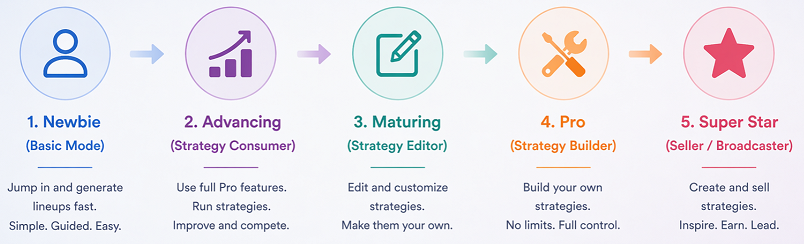
The five-stage user journey.
From Lineup Generator to Strategy Platform
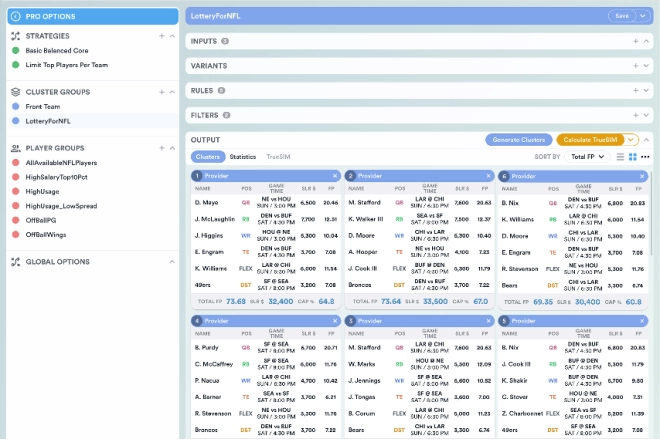
Next Gen is being designed around something much larger than a collection of optimizer features: strategies. Strategies can be assembled from reusable player groups, cluster groups, rules, filters, variants and custom data. They can be saved, modified and reused.
And you won't be limited to a single strategy or a single source of projections. Multiple strategies can operate within the same lineup portfolio, across multiple projection universes representing different views of the slate. The optimizer becomes a framework for expressing how you want to play DFS.
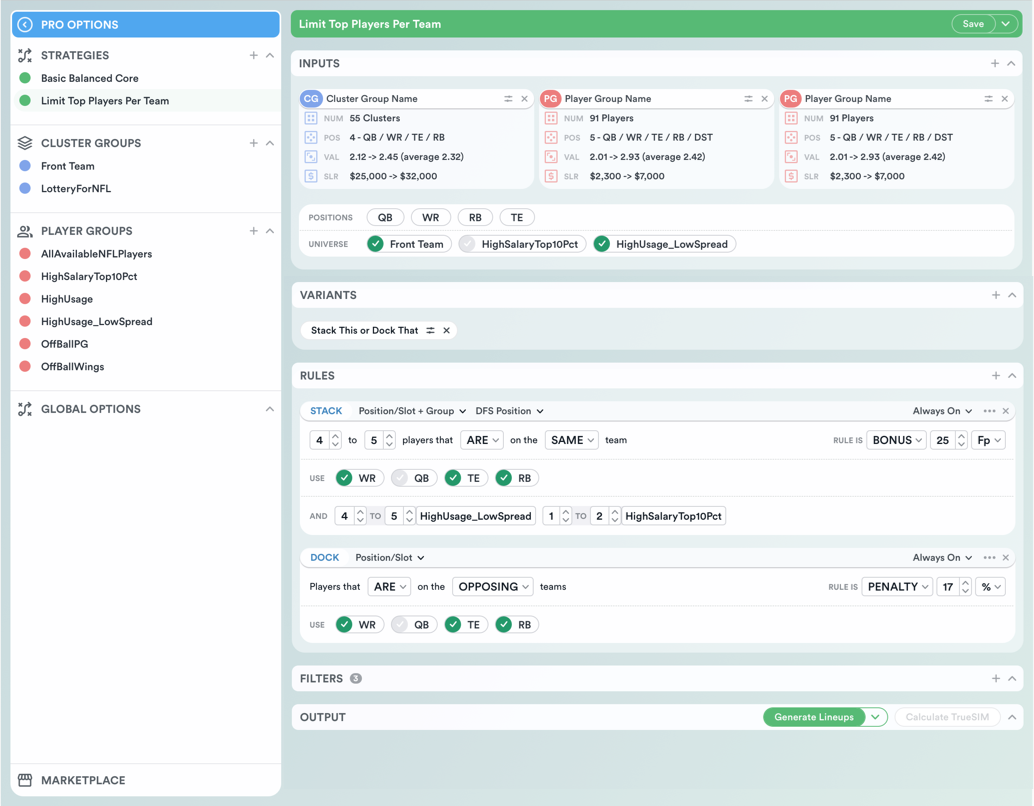
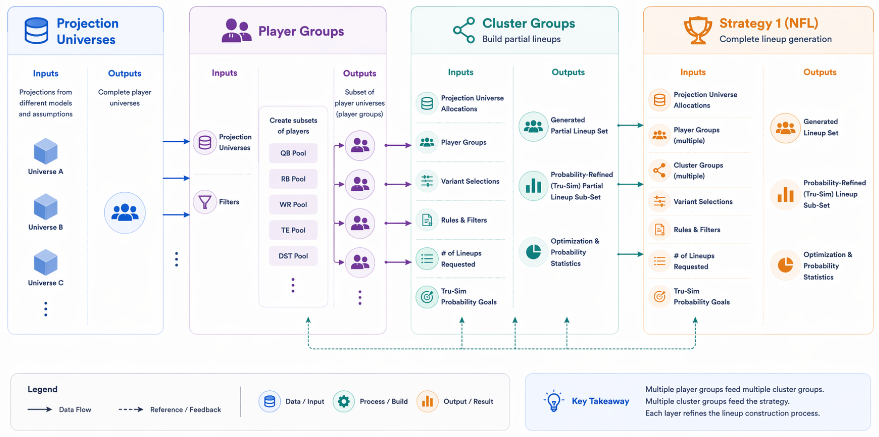
Multi-Strategy Mix
Next Gen is also being designed to let you combine multiple strategies inside the same lineup portfolio. For example, you might want a core strategy driving 93% of your lineups, while reserving 7% for a high-risk, high-reward strategy built for rare upside scenarios.
In NFL, that could mean allocating most of your lineups to ASL’s primary main-slate strategy, while using a smaller portion for an early-quarterback-injury strategy. In that approach, a starter-capable backup quarterback creates a rare but potentially valuable salary-leverage opportunity. If the starter exits early, the backup may still produce a strong score at a much lower salary, freeing cap space for the rest of the lineup.
That kind of outcome is unlikely, but the probability of it happening can still be meaningfully higher than the probability of a random lineup finishing first in a very large-field contest. Used in a limited and disciplined way, that makes it a reasonable source of upside. This is part of what we mean when we say Next Gen is being built as a strategy platform, not just a lineup generator.
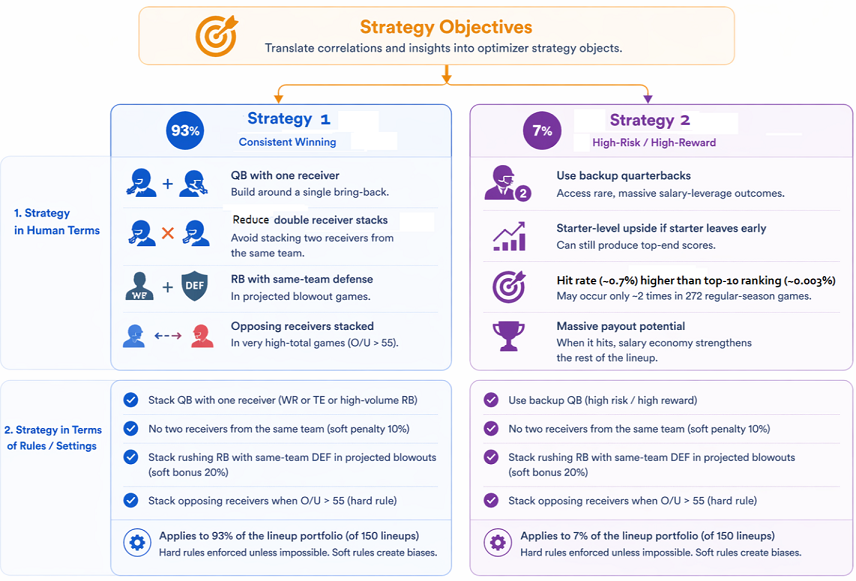
Example of a multi-strategy portfolio: a core NFL strategy combined with a small high-upside allocation.
Optimize the Portfolio — Not Just the Next Lineup
Most lineup generators fundamentally work by finding a strong lineup, then another, then another. Next Gen is designed to optimize the lineup portfolio as a whole.
The optimizer can balance different strategies, projection universes, rules, exposures and other objectives simultaneously, progressively refining the entire portfolio instead of merely producing a sequence of individually optimized lineups. This is where the mathematics behind Next Gen becomes particularly important.
Tru-Sim: It's All in the Math
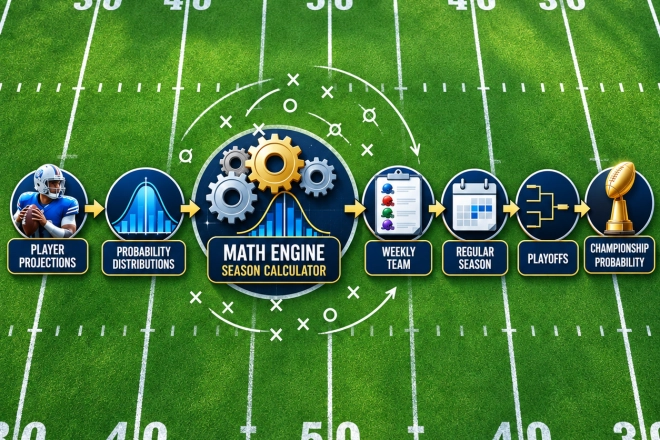
“It's All in the Math” has always been ASL's philosophy, and Next Gen brings that philosophy directly into DFS through Tru-Sim.
The strategy optimizer first creates a large pool of strong candidate lineups. Tru-Sim then applies probability mathematics—including correlations both within individual lineups and across the entire lineup portfolio—to select the final portfolio that best matches your probability goals.
Within a lineup, player outcomes are often related. A quarterback and his receiver tend to rise together, while a batter and the opposing pitcher tend to work against one another. Similar relationships exist throughout every sport, but correlation also matters between lineups.
Two lineups built around very different game scripts may perform very differently under the same real-world outcome. For example, one NFL lineup might benefit from a heavy passing game while another is built around a heavy rushing script. Those lineups can be negatively correlated—so an outcome that hurts one may increase the probability that the other performs well.
Tru-Sim can use these relationships to create greater diversity, uniqueness and contest coverage across the portfolio—even when every lineup comes from the same underlying strategy. Traditional stacking, exposure and diversity rules attempt to capture pieces of these effects. Tru-Sim is designed to go further by evaluating the underlying probability relationships directly, both inside each lineup and across the portfolio as a whole.
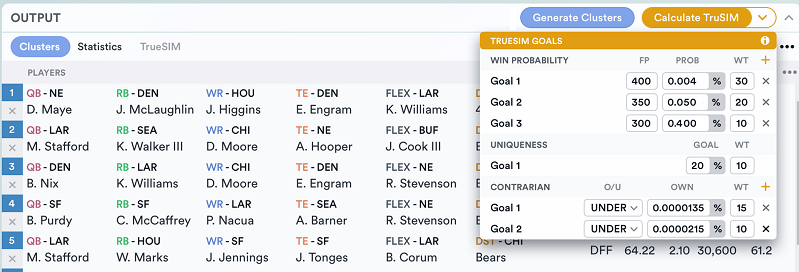
Tru-Sim Goal Settings
Competitive DFS Without Being Chained to the Optimizer
Competitive DFS increasingly requires reacting to late news and changing conditions, but it should not require spending the entire day sitting in front of an optimizer.
Next Gen is designed to support scheduled reoptimization before later games. It can react to new player information and to how your existing portfolio is performing. A lineup already performing strongly may call for protecting that position, while a lineup that is trailing badly may need greater upside.
The optimizer can perform that work automatically and deliver updated lineups ready for upload.
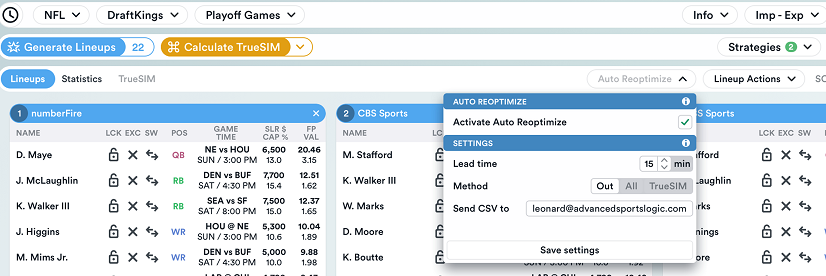
Auto-Reoptimize Setup
An Optimizer That Keeps Evolving
Next Gen is not intended to become another static tool that experienced players eventually outgrow. Strategies can evolve, projection universes can change, you can introduce new data, and community developers can introduce entirely new approaches.
Over time, the optimizer can also learn from the contests you actually play, helping refine probability targets for different sports, contest types and playing styles. We also envision AI becoming a true strategy assistant—one that understands your strategies, settings and results and can help you understand, modify and improve them.
The objective is for you to keep finding new ways to improve inside the platform.
Beyond an Optimizer
Longer term, Next Gen can become an ecosystem. Strategy developers can create and share strategies, projection providers can offer different projection universes, and you can discover new approaches developed by other members of the community.
As you become more sophisticated, you can progress from strategy consumer, to strategy editor, to strategy developer—and ultimately to someone whose ideas benefit other players. You can move to new strategies without having to move to a new tool.
The Road to Next Gen
There is substantial work between today's optimizer and this vision, and we are going to build it one step at a time. First: complete the final cleanup and stabilization of today's DFS Optimizer. Then: begin introducing Next Gen capabilities incrementally rather than waiting for one enormous replacement release.
We'll share designs, development progress and new capabilities as that transition unfolds. The current DFS Optimizer is not the end of the road. It's the foundation for what comes next.
