Our immediate priority is to complete the final cleanup and stabilization of today's DFS Optimizer. There are still smaller issues and usability improvements to address, and we want to finish that work before shifting our primary development effort toward the next generation.
After that, we will begin moving incrementally toward the Next Gen DFS Optimizer. Rather than waiting for one enormous replacement release, we plan to introduce new capabilities as they become ready while progressively evolving the optimizer toward the new architecture.
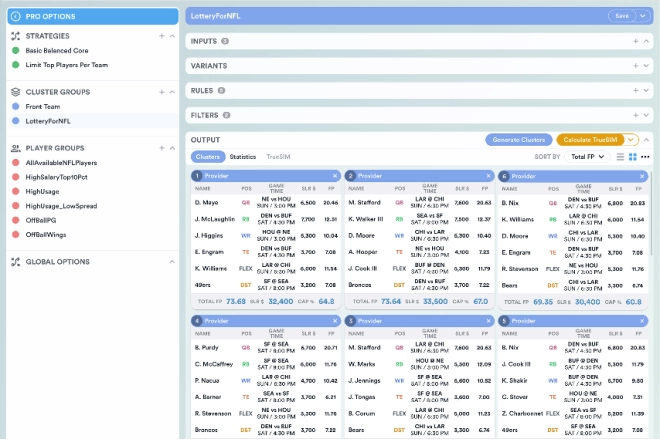
Next Gen DFS Optimizer — interface design.
Next Gen is much more than a new feature list. The major capabilities we are designing include:
-
Basic and Pro modes — Newer players will be able to generate competitive lineups without learning every advanced control. As you become more sophisticated, Pro Mode will open much deeper strategy and optimization capabilities.
-
Reusable strategies — Strategies can be built from player groups, cluster groups, rules, filters, variants and custom data. You will be able to run ASL strategies, modify them, or eventually build your own.
-
Multiple strategies in one portfolio — A lineup portfolio will not have to follow a single approach. For example, you might allocate most lineups to a core strategy while reserving a smaller percentage for a high-risk, high-upside strategy.
-
Multiple projection universes — You will be able to work with multiple projection sources or models at the same time. Each provides a different view of how the slate may unfold, giving the optimizer more possibilities to explore.
-
Portfolio optimization — Instead of simply generating the next-best lineup repeatedly, Next Gen is designed to optimize the entire lineup portfolio together, balancing multiple strategies, rules, exposures and objectives.
-
Tru-Sim probability optimization — Tru-Sim will use probability mathematics and correlation to evaluate both relationships within lineups and between lineups. This can help improve diversity, uniqueness, game-script coverage and the probability characteristics of the overall portfolio.
-
Scheduled reoptimization and late swap — Next Gen is being designed to react to late news and changing contest conditions without requiring you to remain at your computer all day. Updated lineups can be generated automatically and delivered for upload.
-
Learning from your results — Over time, the system can learn from the contests you actually play and help refine probability targets for different sports, contest types and playing styles.
-
AI strategy assistance — We envision AI as a true strategy assistant that understands your strategies, settings and results and can help explain, modify and improve them.
-
Strategy and projection ecosystem — Longer term, strategy developers will be able to share or sell strategies, projection providers can offer additional projection universes, and the community can introduce new approaches that continually expand what the optimizer can do.
We currently believe Next Gen is roughly a year away, although the schedule will depend on development progress. We have not yet determined what the Next Gen Optimizer will cost. However, ASL has a long-standing policy of not increasing the optimizer price for existing subscribers who keep their subscriptions active. Our best current value is the $99.99 annual subscription.
For a more detailed look at what we are building, including screenshots of the new interface and examples of how the strategy system will work, read ASL's Next Generation DFS Optimizer
If you have a feature request or suggestion, send it to